Blueprints and Scenarios
Most high-level logic (especially level scenarios) is defined through Blueprints. Each Blueprint node can have the following:
- Execution IN pin — the node performs work when this pin receives an execution signal.
- Execution OUT pin — this pin produces an execution signal.
- Input data pin — connected to other Blueprint nodes.
- Output data pin — when data is requested, this node performs work and returns a value to the requester.
- Parameter fields — static values.
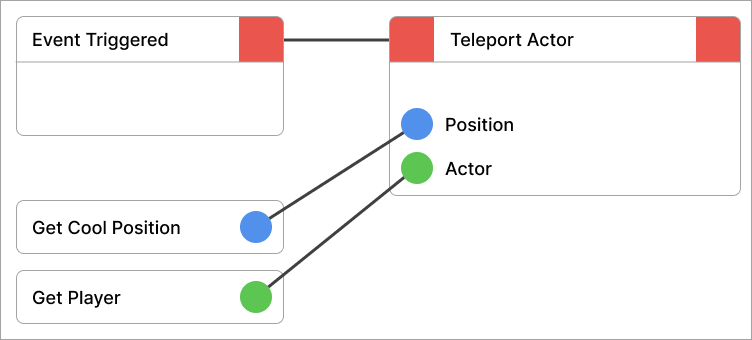
Blueprints in Warhammer 40,000: Space Marine 2 are quite similar to Blueprints in Unreal Engine. Each node is an SSL class, and a Blueprint itself is an SSO file — a collection of node definitions.
Blueprints also use blackboards (like behaviour trees) to store their parameters and local variables.
Blueprints can be executed on the server or client side.
- Level Scenarios are Blueprints. All level logic is defined by a server and a client scenario.
- Actors can have Prop Blueprints and can have Blueprints attached to them.
- Abilities can be designed with Blueprints.
Warhammer 40,000: Space Marine 2 © Games Workshop Limited 2024. Space Marine, the Space Marine logo, GW, Games Workshop, 40K, Warhammer, Warhammer 40,000, 40,000, the 'Aquila' Double-headed Eagle logo, and all associated logos, illustrations, images, names, creatures, races, vehicles, locations, weapons, characters, and the distinctive likeness thereof, are either ® or TM, and/or © Games Workshop Limited, variably registered around the world, and used under licence. Focus Entertainment and its logos are trademarks, registered or not, of Focus Entertainment. Saber Interactive and its logos are trademarks, registered or not, of Saber Interactive. Powered by Wwise © 2006 – 2024 Audiokinetic Inc. Havok software is © 2024 Microsoft. Uses Bink Video. Copyright © 1997-2024 by Epic Games Tools LLC. All rights reserved to their respective owners.